


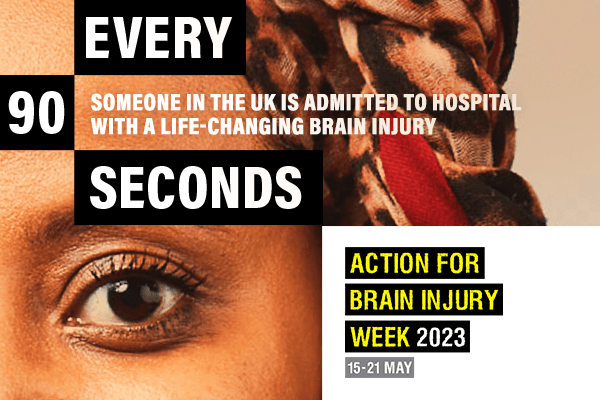
15 May to 21 May 2023 is Action for Brain Injury Week. The campaign is run by Headway, the Brain Injury Association, to raise awareness about brain injury and its life-changing effects on survivors.
The aim of the week is to empower brain injury survivors to talk about the impact of their injury and how it makes their life more challenging. In addition, the campaign encourages the wider public to be more understanding through better insight into the invisible challenges faced every day by those dealing with a brain injury.
This year, the theme is ‘Every 90 Seconds’ which relates to statistics from Headway UK which show that one person is admitted to hospital with an acquired brain injury every 90 seconds in the UK. As Headway state:
“It only takes a few seconds for a life to be completely knocked off course.
“Brain injuries can have devastating, life-long effects on anyone, including you and your loved ones.”
Colin Morris, Director of Communications at Headway, said about this year’s campaign:
“Every 90 seconds, someone in the UK is admitted to hospital with a brain injury – it’s a startling statistic that I’m sure will stop many of us in our tracks.
“People tend to think these things only happen to other people, but the reality is brain injuries can impact any of us at any time – and it only takes a second for someone’s life to be changed forever.
“During the campaign, we hope people will take a second to learn more about brain injury through powerful stories like Nigel and Paula’s.
“We want people to see how they can support our work to rebuild meaningful lives and to take a second to consider donating their time volunteering with Headway or simply to share our message.”
Traumatic brain injuries
There are various causes of traumatic brain injury (TBI), which occur when the brain is suddenly and violently jolted or shaken. TBIs can be mild, moderate or severe. Mild TBI is also referred to as a concussion.
The most common causes of TBI include:
- Falls – which are the leading cause of TBI, particularly among young children and older adults.
- Road traffic accidents – these accidents often involve high speeds and can result in severe head injuries.
- Violence – assaults, domestic violence, and gunshot wounds are all potential causes of TBI. These injuries may be intentional or unintentional.
- Sports injuries – athletes in contact sports, such as football, boxing, and rugby, are at risk of TBI due to the physical impact involved in these sports.
- Explosive blasts and combat injuries – those in the military who are exposed to explosions or combat-related injuries are at risk of TBI due to the force of the blast and shrapnel.
It is important to note that TBI can also occur from non-traumatic causes, such as stroke, tumour, or infection.
Every year, roughly 150,000 people are admitted to hospital with a head injury that can result in a TBI, which can have life-altering consequences for victims and their families.
UK hospital admissions for brain injuries
Headway has published a dataset of all acquired brain injury (ABI) related hospital admissions in the UK using hospital admissions data. The following table sets out the figures for meningitis, brain tumour, stroke, and head injury admissions.
| Type of injury | The average number of hospital admissions |
| Meningitis | 7,000 |
| Brain tumour | 36,000 |
| Stroke | 122,000 |
| Head injury | 150,000 |
*Data is for England, Wales, and Northern Ireland hospital admissions only and based upon Headway’s Hospital admission statistics over a 10-year period.
How you can support Action for Brain Injury Week
Headway is calling on all individuals and organisations to support Action for Brain Injury Week by highlighting the subject of brain injury by sharing support, lived experiences, and holding fundraising events and activities across email and social media.
Headway’s website has more information about Action for Brain Injury Week as well as helpful resources, information, and support generally for those dealing with brain injury and their families on their website.
Brain injury compensation claims
Sadly, brain injuries are often the result of an injury caused by negligent medical care or treatment, or in an accident. If you or a loved one have suffered a brain injury as a result of medical negligence or an accident that wasn’t your fault, then you may be able to make a brain injury claim.
When it comes to compensation for brain injury claims, there is no set amount. The level of compensation awarded is dependent on the individual circumstances and will depend on the impact the injury has had on the person’s life. The value of using a specialist personal injury or medical negligence solicitor is that they have expert knowledge of these types of claims.

How can Nelsons help?
Danielle Young is a Legal Director in our Medical Negligence team, which has been ranked in tier one by the independently researched publication, The Legal 500.
At Nelsons, we have a team of experts with particular expertise in brain injury claims. We have helped many victims with brain injuries claim compensation.
Our dedicated solicitors know how a brain injury can affect families’ lives and have extensive experience in managing complex cases.
We understand the support and rehabilitation needs of victims of serious injuries and can help ensure that you are compensated for financial assistance and your ongoing medical rehabilitation needs. We work closely with medical and rehabilitation teams to get the best outcome for you.
If you have any questions or require some advice, please get in touch with Danielle or another member of the team in Derby, Leicester, or Nottingham on 0800 024 1976 or via our online form.
Contact us